
This site celebrates the life and work of sculptor John
Cassidy (1860 - 1939).
The John Rylands Library took nearly ten years to build, starting in 1890 and opening to readers in 1900. For more about the Library, see our Enriqueta Rylands page.
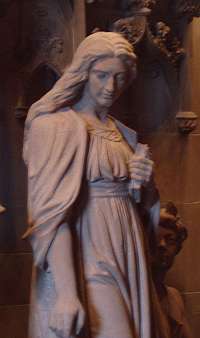
Note: Unfortunately, since the opening in 2007 of the Library's new entrance wing to the side of the original building, this work is no longer seen by many visitors, as it is necessary to walk to the far end of the Reading Room, or to the far end of the exhibition corridor, and descend Champneys' main staircase to reach the original main entrance vestibule. The detour is well worth the effort, however, to see the impressive architecture of this area as well as Cassidy's sculpture.
On the brighter side, however, the view of the sculpture is no longer obstructed by a display of publications for sale.
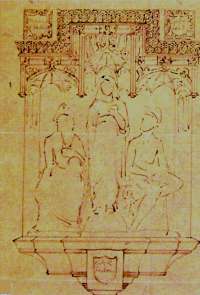
A working sketch, from the Library archives.
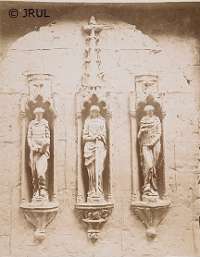
This photograph shows a model made by Cassidy early in the project, and rejected by Mrs Rylands. She disliked the niches, and wrote that 'the present appearance of three statues in a line all one height and size looks to me anything but striking and too much like the statues one sees in a cathedral.'
Having no aesthetic use for this photograph, she used it to stiffen a bundle of book lists thus accidentally ensuring its survival, although badly faded and torn.
Links and references:
The John Rylands Library, visitor and general information
Enriqueta Augustina Rylands (John Rylands Library)
Basil Champneys (John Rylands Library)
Douglas A. Farnie: "Enriqueta Augustina Rylands, 1843–1908, Founder of the John Rylands Library". Bulletin of the John Rylands University Library of Manchester Vol.71,no. 2: 3–38. (1989). Full text available online.
"Rylands , Enriqueta Augustina (1843–1908)", Oxford Dictionary of National Biography, Oxford University Press, online edition, Oct 2006 (subscription required)
Theology Directing the Labours of Science and Art
The John Rylands Library, Manchester
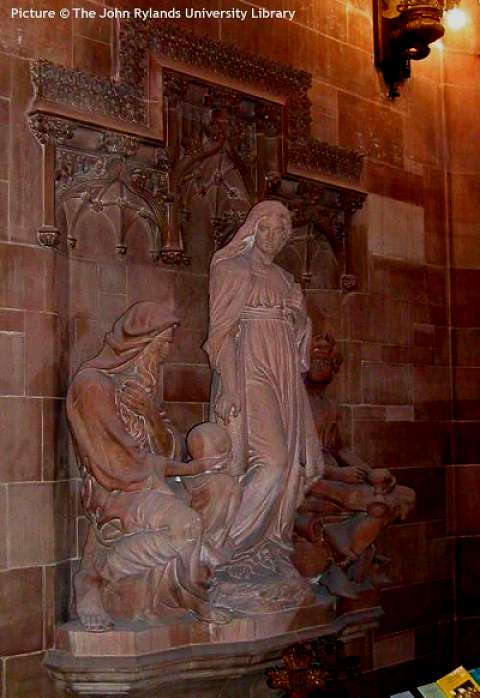
Cassidy's group Theology Inspiring Science and Art dominates the original main staircase of the John Rylands Library, although the similarity between its stone and that of the wall of the building creates a somewhat spectral effect, especially in a photograph.
This is the story of the work, from the Library's publication John Rylands of Manchester by Douglas Farnie:
In the foyer a group of statues,
placed in position in February 1898,
symbolized the superiority of Theology to both Science and Art. The
group of three figures embodied the founder's own idea of the library's
essential function. Mrs Rylands wished to make the group the central
feature of the foyer. She insisted that the figures should stand out
boldly from the wall and should not be cramped up in niches. In 1893
she considered, in a letter written to William Linnell
on 8 March,
whether the central statue of Religion should be seated, with 'the
shield of faith' and 'an open Bible'.
In 1895 she thought the group might most appropriately be surrounded by the coats of arms of the four cities of Manchester, Salford, Wigan and London. She abandoned both of those ideas but remained firm in her commitment to boldness of treatment of the group. She would not accept a proposal by the architect [Basil Champneys] to moderate the impact of the central figure. Champneys thought that a six-foot female would have the effect of dwarfing the interior of the vestibule. He favoured a height of four feet six inches to five feet: in the event the height became five feet four inches. John Cassidy took three full years to complete the sculpture in red Shawk stone.
The finished work embodied in full the vision of Mrs Rylands. The group remains the most inspiring work of statuary in the whole building. It impresses visitors powerfully with a sense of other-worldly values and is reputed to have been sometimes mistaken for a statue of the Virgin Mary, an interpretation which would have dismayed Mrs Rylands.
In 1895 she thought the group might most appropriately be surrounded by the coats of arms of the four cities of Manchester, Salford, Wigan and London. She abandoned both of those ideas but remained firm in her commitment to boldness of treatment of the group. She would not accept a proposal by the architect [Basil Champneys] to moderate the impact of the central figure. Champneys thought that a six-foot female would have the effect of dwarfing the interior of the vestibule. He favoured a height of four feet six inches to five feet: in the event the height became five feet four inches. John Cassidy took three full years to complete the sculpture in red Shawk stone.
The finished work embodied in full the vision of Mrs Rylands. The group remains the most inspiring work of statuary in the whole building. It impresses visitors powerfully with a sense of other-worldly values and is reputed to have been sometimes mistaken for a statue of the Virgin Mary, an interpretation which would have dismayed Mrs Rylands.
Basil Champneys had, apparently, suggested Cassidy's London-based contemporary George Frampton (1860-1928) as sculptor, but he was overuled by Mrs Rylands, who insisted on Cassidy, who she already knew from his work on the statue of her late husband. She took a personal interest in the work (as she did in many other aspects of the Library), visiting the Lincoln Grove studio to view progress.
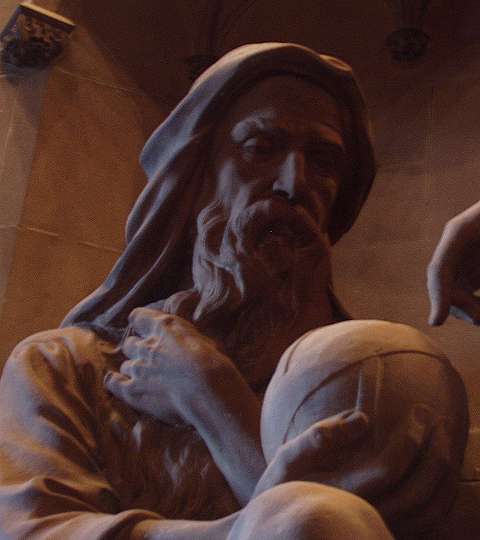
' Science.'
The Librarian of the time, Henry Guppy, wrote of this work in 1924:
The group is intended to
represent Theology, Science and Art.
Theology, the central standing figure of a woman, clasps in her left
hand the volume of Holy Writ, and with the right hand directs Science,
in the guise of an aged man seated, and supporting in his hand a globe,
over which he bends in study and investigation.
On the left-hand side of theology is the seated figure of a youthful metal-worker, as representing Art; he has paused in his work of fashioning a chalice, and with upturned face listens to the words which fall from the lips of Theology. The lesson which this group is designed to symbolize and teach is, that Science and Art alike derive their highest impulses and perform their noblest achievements only as they discern their consummation in religion.
On the left-hand side of theology is the seated figure of a youthful metal-worker, as representing Art; he has paused in his work of fashioning a chalice, and with upturned face listens to the words which fall from the lips of Theology. The lesson which this group is designed to symbolize and teach is, that Science and Art alike derive their highest impulses and perform their noblest achievements only as they discern their consummation in religion.
The images on this page are included by kind permission of The John Rylands University Library's Heritage Imaging team, e-mail uml.chicc@manchester.ac.uk, and must not be reproduced without permission.
Page created by Charlie Hulme 2004. Updated July 2013